Water-Fed Cleaning Poles vs Traditional Window Cleaning: Which Is Better?
September 15, 2026 | TANUJ GUPTA
Choosing between water-fed cleaning poles and traditional window cleaning shapes how safely and efficiently you work. Both methods clean the windows, but they do so in very different ways.
The water-fed cleaning polesvs. traditional window cleaning debate typically focuses on three main factors: safety, cleaning quality, and cost. Professionals switching methods want to know which one actually pays off.
This guide breaks down both approaches so you can decide what fits your jobs, your budget, and your comfort with heights.
What Are Water-Fed Cleaning Poles?
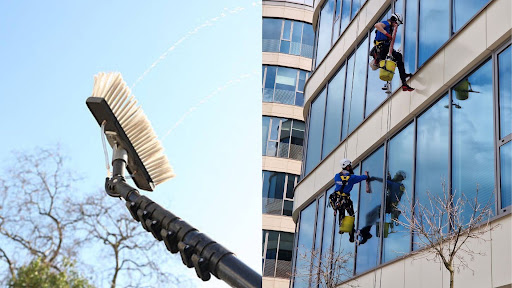
Water-fed poles for window cleaning are telescopic poles fitted with a brush head and fed by purified water pumped from a tank or backpack. They stretch from around 20 feet to over 60 feet, letting you clean upper-storey glass without a ladder.
Purified water contains no dissolved minerals, so it dries without streaks or spotting. That means no squeegee pass, no chamois, and no drying step at all.
What Is Traditional Window Cleaning?
Traditional window cleaning relies on a bucket, a squeegee, applicator sleeves, and often a ladder. It’s the method most people picture when they think of a window cleaner.
It demands practice. Getting a clean, even pull with a squeegee across a full pane takes weeks to master, and ladder positioning requires real judgement on uneven ground.
Where Traditional Methods Still Fit
Ground-floor jobs, small shopfronts, and detail work around tight frames are where traditional tools still shine. Close contact with the glass gives you more control in fiddly spots.
Water-Fed Cleaning Poles vs Traditional Window Cleaning: Key Differences
The two methods differ most in their reach, safety, and the duration of their results.
- Reach: poles extend well past ladder height; traditional methods stop where a ladder safely can.
- Residue: purified water leaves none; soap-based cleaning can leave a thin film that attracts dust.
- Setup time: poles need a water tank and pump running; buckets need refilling and dumping.
- Physical position: pole work happens from the ground; traditional cleaning puts you at the window.
Advantages of Water-Fed Cleaning Poles
- No ladder, so no fall risk on multi-storey buildings.
- Windows stay clean longer because pure water leaves nothing behind for dust to cling to.
- The frame and sill areas are rinsed along with the glass.
- Faster on large jobs once the system is set up and running.
- Works from a distance, which residents often find less intrusive.
Advantages of Traditional Window Cleaning
- Lower cost to get started; a bucket and squeegee are cheap.
- No dependence on water purification equipment or a power source.
- Precise control for awkward corners, stained glass, or heavily leaded frames.
- Familiar to most clients, with a visible, hands-on process they trust.
Comparison Table: Water-Fed Cleaning Poles vs Traditional Window Cleaning
| Factor | Water-Fed Cleaning Poles | Traditional Window Cleaning |
| Typical reach | Up to 60+ feet from the ground | Limited to safe ladder height |
| Residue after drying | None; water evaporates clean. | Possible soap film |
| Safety | Ground-based, no fall risk | Ladder use carries fall risk. |
| Startup cost | Higher, pole and pump setup | Lower, basic tools only |
| Best suited for | Multi-storey, frequent-access buildings | Ground floor, detail work |
| Weather sensitivity | Affected by high wind and freezing | Affected by rain, wind, and ice on ladders |
Which Method Delivers Better Cleaning Results?
For pure glass clarity, purified water tends to win. Nothing is left behind to attract grime, so windows genuinely stay cleaner between visits.
As one long-serving window cleaning trainer puts it, “The water does the work once it’s pure enough; the pole is just there to guide it.” Traditional cleaning still delivers a sharp finish, but it depends more heavily on the operator’s technique and the quality of the squeegee rubber.
Which Window Cleaning Method Is Best for Your Needs?
If you’re regularly working on two-storey homes, office blocks, or anywhere ladders become a liability, water-fed poles are worth the investment. The upfront cost is offset by fewer callbacks and safer working days.
If your work is mostly on ground-floor residential properties or small commercial fronts, traditional window-cleaning tools may still be the simpler, cheaper choice. Many cleaners end up running both, picking whichever suits the job in front of them.
Frequently Asked Questions
They're better for reach and safety on taller buildings, and results tend to last longer. Traditional cleaning still holds its own for ground-floor or detail-heavy jobs.
No. Because the water has been purified, there's nothing left on the glass to dry into streaks or spots.
Yes. Most poles extend well beyond that height, and some professional-grade poles reach 60 feet or more, covering many mid-rise buildings.
Yes, particularly for ground-level work, tight frame detailing, and jobs where a pole simply isn't practical.
For anyone doing regular upper-storey work, yes. The safety benefit alone, combined with fewer repeat visits, usually justifies the higher starting cost.


 0 Cart